Breakfast Show
PuntWG, Amsterdam, 2016
An exhibition curated by Erica van Loon
4 – 26 June 2016: Fri - Sun, from sunrise (around 5.30 am) – 10.00 am
With works by: Charlotte Dumas, Priscila Fernandes, Rosie Heinrich, Erica van Loon, Timmy van Zoelen
Laying the Table, Setting the Stage
An essay by Eve Kalyva about Breakfast Show
What changes when we view art first thing in the morning? Setting this question as the starting point of inquiry, Breakfast Show (2-26 June 2016, PuntWG, Amsterdam, curated by Erica van Loon) engages with different modes of experience and the time and space that one’s body occupies. It particularly explores ideas about awareness, intimacy and interpersonal communication.
The role of the curator has become increasingly theorised in recent years. It is often compared to that of an orchestrator or mediator, and the curatorial practice as adhering to the principles of montage and as having a didactic potential (Lind 2012, Martinon 2013). This means that apart from its contents, the how an exhibition is organised is important in the mediation as well as in the shaping of the visitor’s experience. Indeed, the structure of the exhibition itself can have performative and reflective elements that form an additional layer of engagement with art and can help raise and maintain more general questions.
Breakfast Show is a good example of this. A well-conceived and executed exhibition, the works on show are carefully combined in terms of form and content and presented in an immersive yet thought-provoking way that further draws to the surface questions about staging. Specifically, Breakfast Show incites the visitor to reflect on how one’s experience is staged and, perhaps more importantly, generates questions regarding one’s expectations of what an art show is and should be doing.
When I arrived at 5:20am, the sky was just turning pink. Everything was very quiet. The first thing I noticed upon entering was that the gallery room was dark and silent. I was curious to see what kind of works would constitute such thing as a “breakfast” show running from sunrise until 10:00. But they weren’t photo stills of landscapes or sound installations of morning activities. The only explicitly morning act was my getting to the gallery when I did.
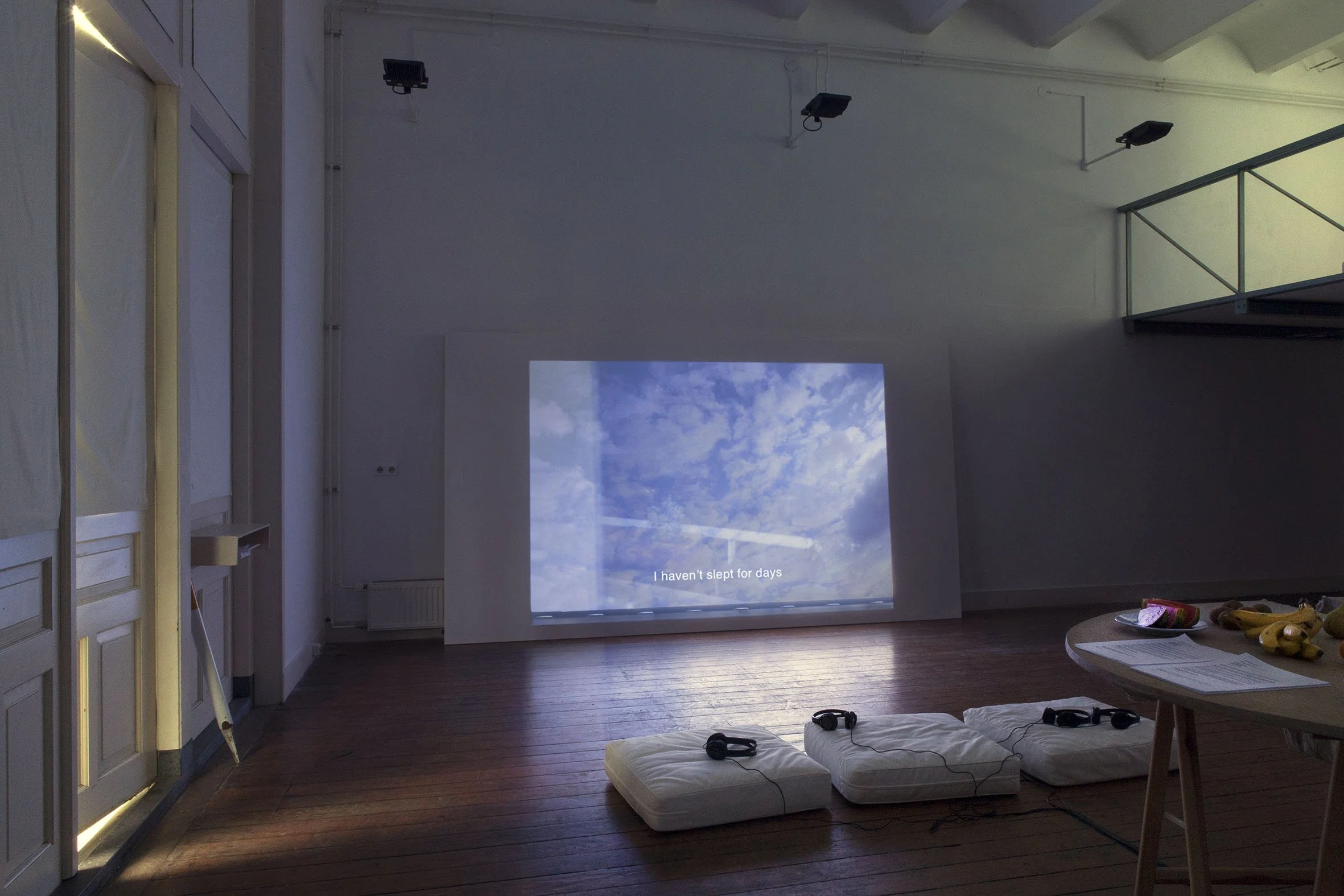
As curiosity was waking up my half-asleep mind, my eyes got accustomed to the dim light of the room. It was a bare setting apart from a very performatic, fully laid breakfast table at the one side of the room and a blue and red glow coming from the opposite wall. The first piece was already on. I sat on the floor cushions and picked up the headset.
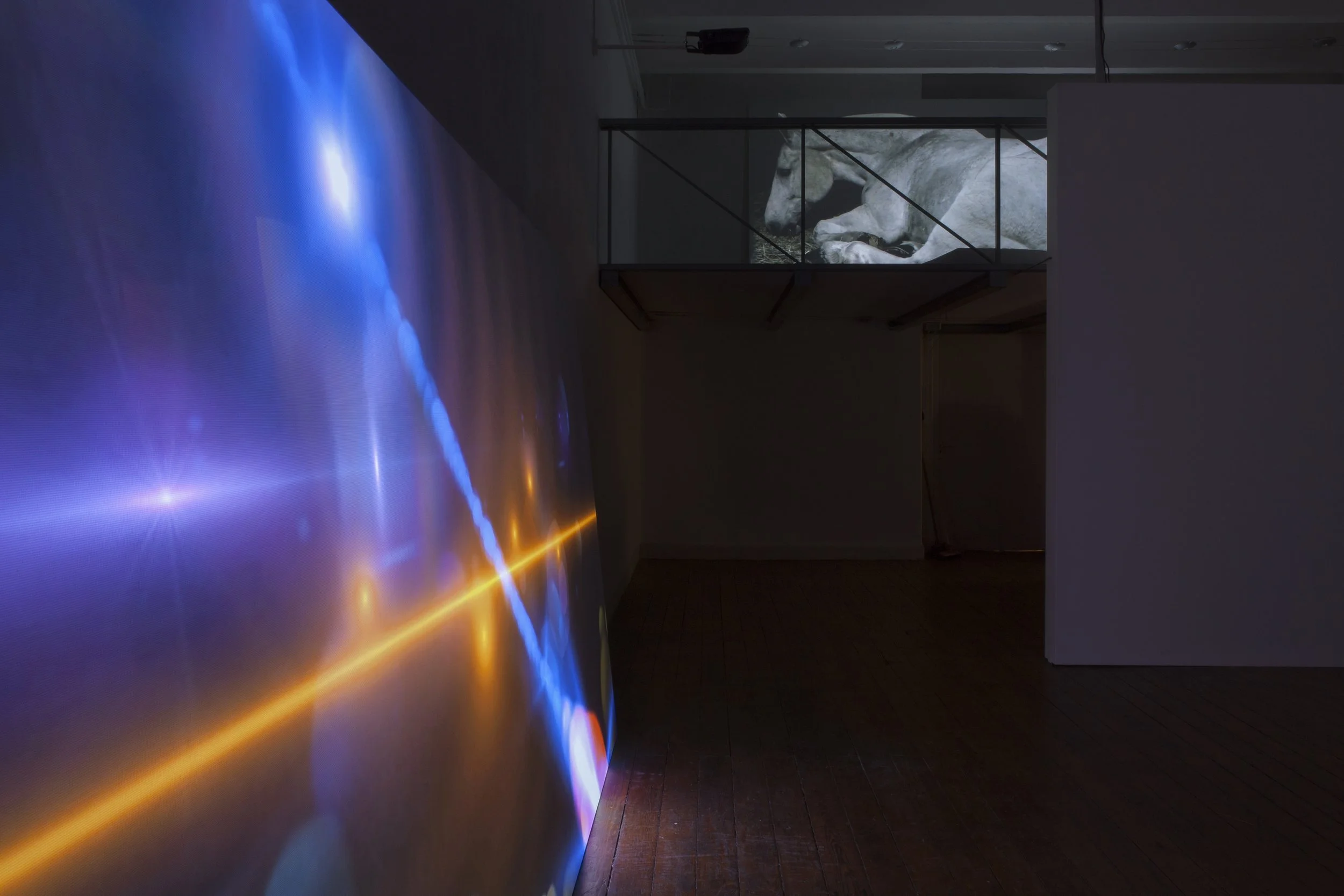
Rosie Heinrich’s It’s possibly the only way that I can walk through myself (2014) skillfully interweaves image and sound in order to open up different imageries and temporalities. Photographs of personal artefacts, interior scenes and clouds reflecting on glass windows succeed one another, fade out and emerge on the screen. They are accompanied by a voice-over and prompt subtitles, yet what one sees and what one hears follow their own rhythm, intensity and register. For example, the image of a bird drawing on the wall next to a bed with a railed headboard lingers on the screen while the accelerating voice of a man talks about rage.
Two narrating voices are set in dialogue with this flow of images. They are also edited in such a way that they seem to be in dialogue with one another. What is more, the viewer is not excluded from this act. The first-person accounts that were given to the artist are not simply offered up to the viewer.
Rather, they gradually transform into an exploration, a dialogue between the work and the spectator. In this process, the rhythmic alternations between different states of mind, of being and of feeling resonate with one’s own and can be understood as different ways of seeing and engaging the world.
This relation between reflection and experience is articulated as a relation between the inside and the outside, the physical and the emotional spaces that the work opens up and the space that the viewer occupies, the real and the imagined, the private and the social. It is as if being in a dream state, the half-awoken spectator realises, of the world as it appears to a mind that gradually becomes more conscious of its own short-sightedness.
The gallery setting enhances this effect. The large projection surface, a partition diagonally placed on the wall and floor, cuts through the architectural space and comes closer to the viewer who sits on the floor. Because of this placement, the screen seems to become an extension of its contents: the experiences, times and places of other people, the interactions across a floating voice and some other body, the shifts between remembering and experiencing, presence and absence. Rather than presenting the work as an already concluded exhibit congealed on the gallery wall, Breakfast Show stages the work in such a way that enables these interactions and interconnections to enter the here and now and to blend with the viewer’s own experiences.
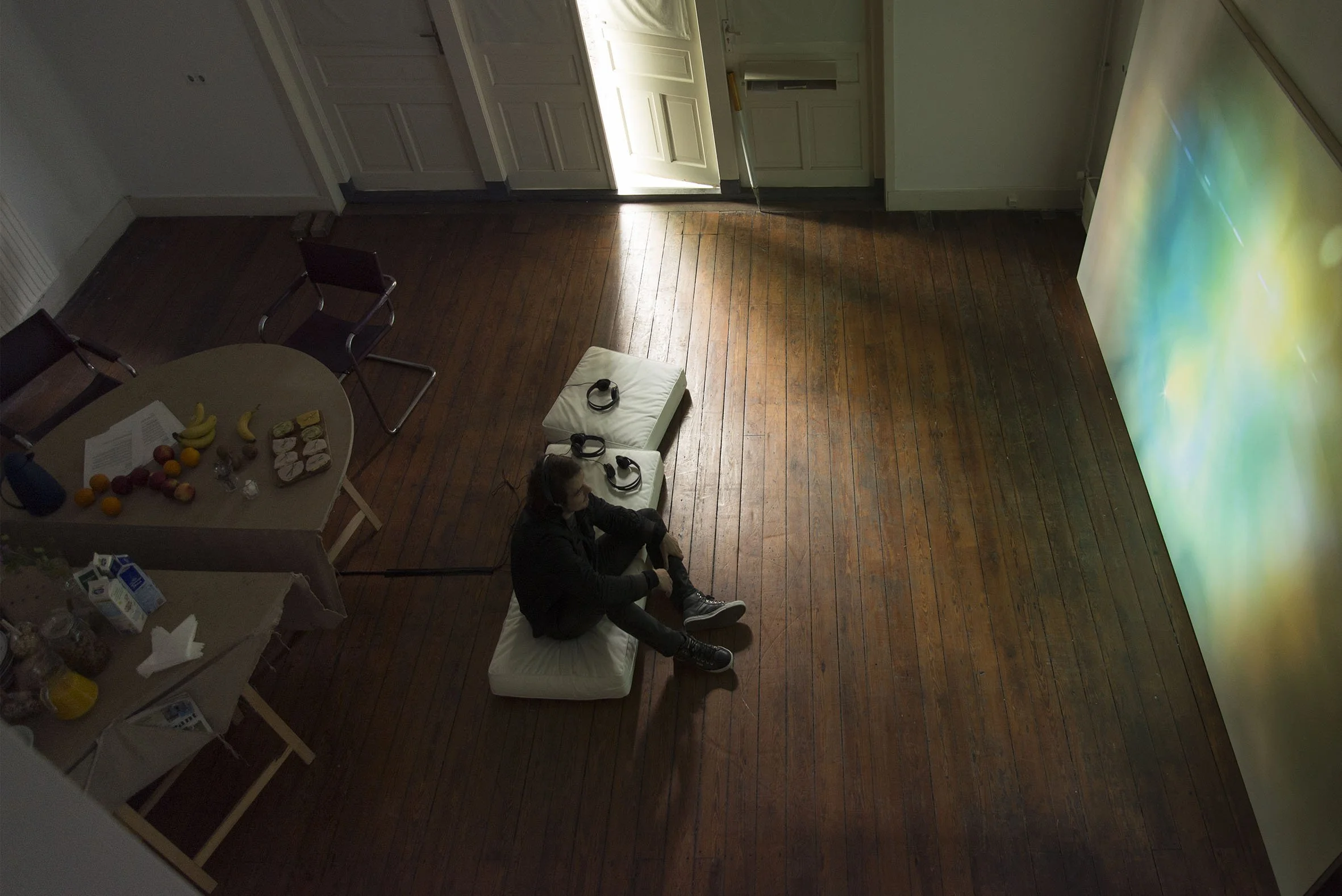
Timmy van Zoelen’s Furious Suns (2011-2014), an excerpt prepared for Breakfast Show, appears as a dawn of light. Another piece technically well made, Furious Suns negotiates Pasolini’s politically charged film Salò o le 120 giornate di Sodoma (1975) and explores the artificiality of light as carrier of meaning. Lens flares shine against a timeless background as one listens to bodily sounds and bodiless voices laden with a rhetoric of refinement and taste. “You see how sensitive I am to the true nature of things” a voice echoes amidst this dance of light and shadow. “Don’t worry, they won’t bite. They’ll only observe you with contempt.”
The work uses lens flares, considered as “ruining” a picture shot and as obscuring what there is to be seen. This creates tension between exposure and cover up and between shedding light on the deepest recesses of the human mind and rendering one’s privileged view inadequate. This, however, is also the point of departure of van Zoelen’s work from its film reference. In Salò, the object is completely exposed under the fixated gaze of the oppressor and yet not much is revealed to the spectator. The scopophilic iterations of the protagonists evoke a frightful imagery as they indulge in self-adoring fantasies that only confess their decadence and corruption, but these are set against the stasis of the picture frame. There is no privileged eye of the auteur and any explicit depiction of violence literally takes place outside, impossible to bear but also impossible to convey in words.
In that sense, Furious Suns does not hide from view what was otherwise shown. But it creates a conjunction between the spectator’s expectations and what one imagines could be seen. This desire to see through the shadows that the shining lights cast can never be fulfilled since there isn’t anything that these obscure. In this way, the work creates a polarisation of mediation, which is further supported by the exhibition layout. In a quiet and dark gallery room, one feels as if being in a theatre of the absurd where, devoid of any other purpose, the roles become inverted and the spotlight turns on the spectator.
The other three videos are upstairs past the breakfast table. There, I diligently take my place on the floor near the screen, used to by now that my body becomes part of the picture.
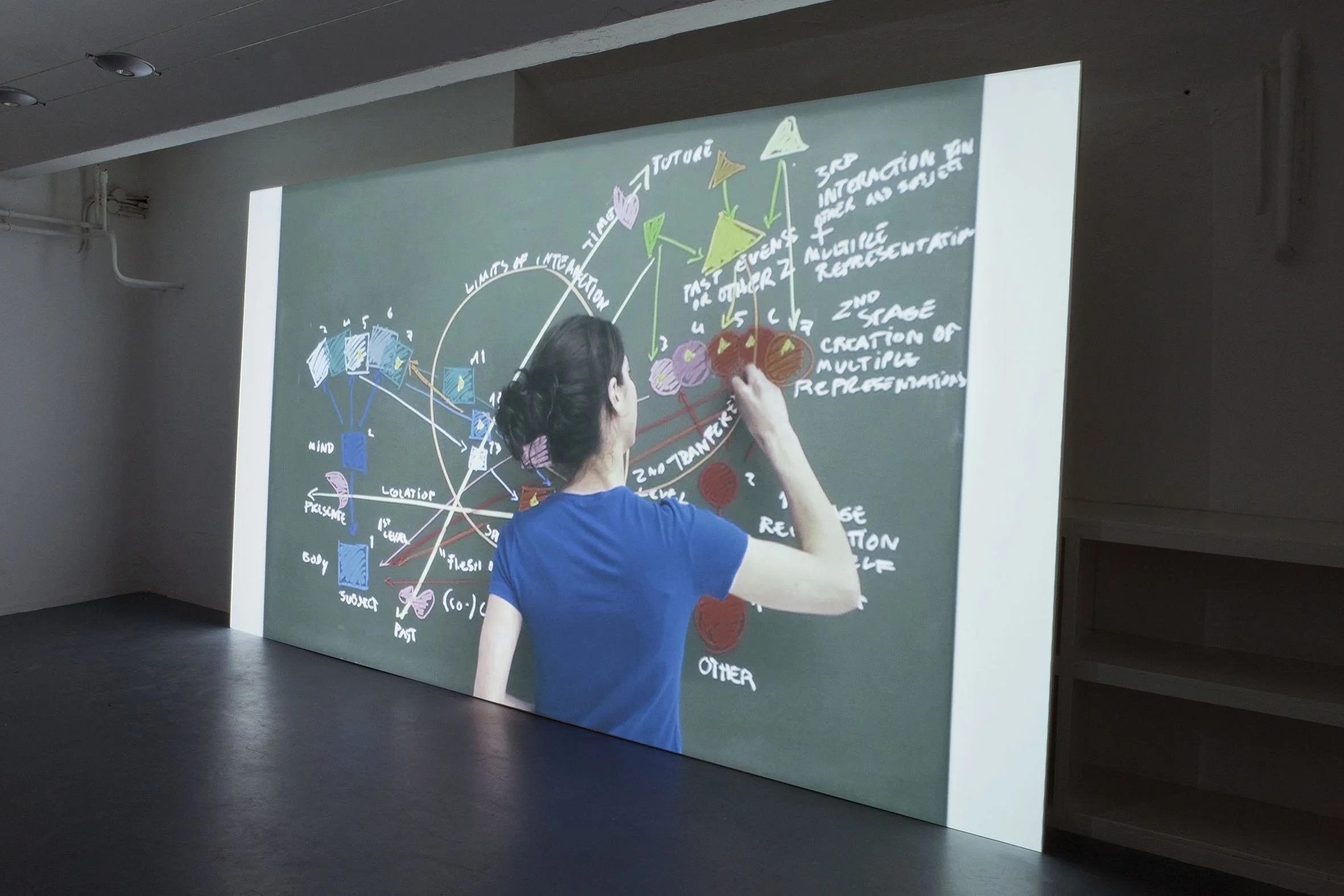
In Search of the Self (2009-2010) by Priscila Fernandes shows a young woman making colourful diagrams on a blackboard and elaborating on some subject/object relations. It could all had been very straightforward, banal even, if it wasn’t for the theatricality of the work to suggest otherwise.
One of the central ideas that comes up with this piece is the abstracted and disjointed manner in which information is often conveyed and how this serves as the means to actualise the authority of the expert to administer that information. To articulate this, In Search of the Self stages a condition for the deprivation of communication.
The video is silenced and all that one hears is the continuous tapping of a chalk piece on the blackboard – but this does not correspond to what one sees: facial expressions of discovery, bodily gestures and indications on the blackboard and a presenter who exits the frame only to re-enter wearing different coloured T-shirts. The longer one waits, the fuller and more colourful the blackboard becomes. But the spectator soon realises that not only one cannot retrieve any information from the presenter’s discourse but that no full and complete enjoyment can be achieved either.
Indeed, the work tries to make one experience the struggle to focus and understand. If through their alternations of light and shadow, Heinrich’s and van Zoelen’s pieces consider the act of bearing witness and whether it is possible to trace or convey that experience visually, Fernandes’ work further asks: can it even be explained?
In parallel, the work’s rhythmical yet suppressed input animates one’s desire and expectation, as a spectator, to be offered some readily available meaning. Here, the dissonance between what one sees and what one hears opens the hermeneutic space of the work. It creates entry points for the viewer and by this also validates an external point of reference. The work’s title adds another performative layer of meaning since the longer one waits, the more time one spends with one’s self. As a result, the work’s disjointed engagement with the effort to explain, rationalise and systematise doubles on the condition of being, or remaining, spectators.

Sitting quite close to the projected images, I wonder: what does one understand when one gives up trying to understand? What remains?
One answer would be: everything else. The conceptual binary between permanence and ephemerality is explored in Erica van Loon’s A Body is not a Part of a Head (2016). Set against the magnitude of Earth’s body and suspended temporality, the piece engages with embodiment, experience and human measure.
Flattened images of rocks with different patterns, colours and shapes soundlessly drop the one on the other while a voice-over gives factual information about their formation and stress lines. One cannot fail to make the link between the body and time of the earth and one’s own body and time, a link formally sustained by the rhythmic flow of images and words. A second layer of engagement that is supported by the gallery setting is the relation between the work and the time and space of the spectator – a dialogue between the work and the world that is common in all the works on show.
In the second part of van Loon’s work, the screen turns black and silent until a hand swishes up from the bottom right corner and its fingers start to snap. This mesmerises one’s gaze now left to wonder over the flesh, bones, skin, fingernails and tendons that are suspended over a depthless background. It will later be replaced by a wobbling stone, its shape resembling that of Earth now extrapolated and out of proportion.
And yet it feels as if it is our own temporalities that are stretched to opposite directions. Our gaze doubles back on our body and numbers and figures about the eons of cosmic existence mean nothing if the passing of time cannot be experienced. This conceptual limitation in measuring and understanding the difference in scale, volume and size becomes our inability to fully comprehend the magnitude of existence.
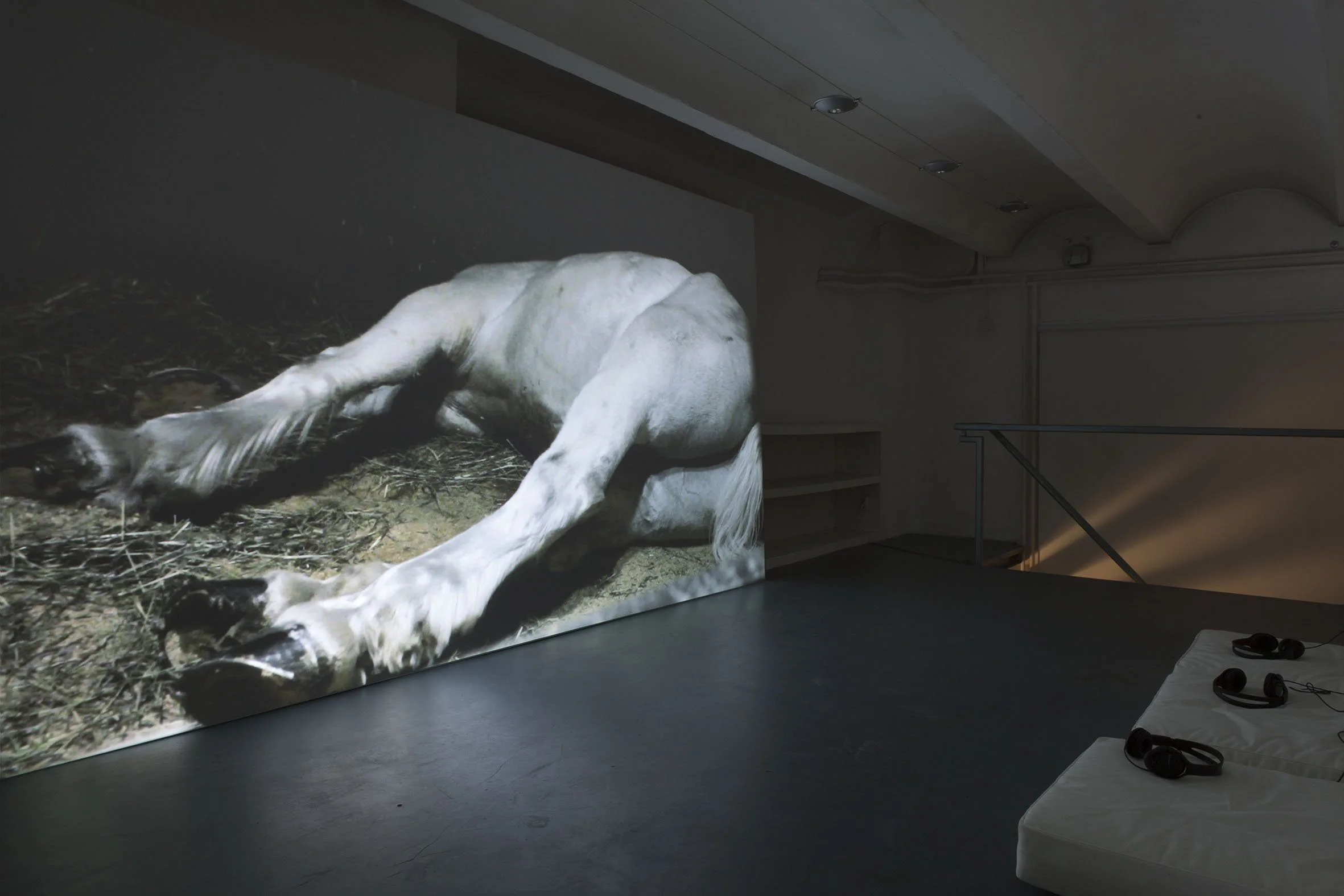
The last piece, Charlotte Dumas’ Anima (2012) brings us full circle back to the subtle yet potent engagement with awareness and intimacy that Breakfast Show orchestrates. Like in the other works on show, its static frame allows the eye of the beholder to freely pass over its contents. Yet in this case, the frame masterfully captures the experience and the body of the other – a body that is moreover confined within our space and time.
The camera’s close-ups trace the twitching muscles, heavy eyelids and exhaling nostrils of horses resting in their boxes after a hard day’s work. Deprived of sound, the proximity and stillness of the video frame give prominence to the photographic and sculptural qualities of the medium. Here, one might observe that what one is watching first thing in the morning are creatures resting, dosing off and falling asleep. But that is beside the point.
The work creates its own time in which the viewer, sharing the same floor with the projected image, is immersed. This intimacy of the viewing experience forms connections across the breathing and the stillness of the viewed object and the viewing subject. But it also creates tension. There is tension between the physical strength and nobility of the horse, this body now arrested and scrutinised, and the vulnerability of the moment in which the creature is captured.
The stasis that the picture frame inscribes on its contents becomes an imposition, which is retained by the work’s mute and inactive exposures. It is also something that is always associated with violence. In the last frame, we see a horse turning its eyes towards us. Alert and aware of being watched it stands up, shakes its body and moves towards the camera. At this moment, we are forced to understand our gaze as an act of intrusion – an intrusion that, in the wider sense, characterises much of our time: the era of spectatorship, the dominion of the prying eyes and the privileged view of the spectator who, safely set on the other side of the screen, remains alienated and alone.
It takes dedication to wake up in the morning specifically to go to the art gallery. The earlier one does so, the closer one comes to the realisation that experience depends on one’s attitude and predisposition as much as it does on the exhibition setting. This is not only in terms of how well a show’s concept and organisation work with the exhibits but also how the setting itself participates in shaping the visitor’s experience and in generating reflection.
In his seminal essay collection Inside the White Cube, Brian O’Doherty (1976) explains how the gallery space is not a neutral container. It is a historically shaped carrier with aesthetic, socio-political and ideological functions; a carrier that, in the guise of some neutral space and time, purports to shield off and preserve the autonomy and timelessness of its exhibits. In our historical context and with the contemporary art market enjoying amongst the highest revenues, our experience of art plays out our customer behaviours. Window shopping from one gallery to the other, rushed and disconnected, browsing through artefacts stuck on the wall and awaiting to be served.
In contrast, and in a subtle self-conscious manner that is lamentably a rarity in the contemporary art gallery scene, Breakfast Show engages with the frame of reference that itself sets. Not only it manipulates space but also time, and its fully laid breakfast table becomes the site of recollection and exchange as well as the link across art and daily life. To make up time for art, then, is to make up time for awareness and reflection.
References
Lind, Maria (ed.). Performing the Curatorial Within and Beyond Art. Berlin: Sternberg: 2012.
Martinon, Jean-Paul (ed.). The Curatorial: A Philosophy of Curating. London: Bloomsbury: 2013.
O’Doherty, Brian. Inside the White Cube: The Ideology of the Gallery Space. Santa Monica: The Lapis Press: 1976.
Exhibition info
Breakfast literally means "breaking the fast" of the night.
During night-time our attention turns inward and almost all input from the outside is paused. We temporarily shift to another state of mind.
Most of the time, an encounter with an artwork is preceded by a multitude of sensory, emotional and intellectual interactions. What would happen if an exhibition is the first thing we are exposed to after waking up, when we have had little sensory activity and almost no interactions with our surroundings.
By moving the usual time frame in which we look at art, the viewer will have a slightly altered state of consciousness. Does this result in a different susceptibility, a different reflection on the works? Does it affect how we perceive the succeeding reality of a day?
Sunrise
As the exhibition was only open in the early morning, from sunrise, visitors were invited to see the video works before engaging in other activities.
Breakfast was served in the exhibition space, to stimulate visitors to reflect in dialogue, which made the breakfast table an important element of the show*
The programme occasionally provided an opportunity to sleep and wake up in the exhibition. On several daybreaks a special guest was invited to join the breakfast discussion and share their insights and knowledge.
* Mandorla (mudpietable) 2008, by Frank Mandersloot
Breakfast Show was a group exhibition, consisting of video works by Charlotte Dumas, Priscila Fernandes, Rosie Heinrich, Erica van Loon en Timmy van Zoelen.
The exhibition was curated by Erica van Loon.
Sunday the 5th of june, 8 AM:
When the Owl of Minerva Returns
A morning conversation with Frans-Willem Korsten, Professor Literature, Culture and Law at the Leiden University Centre for the Arts in Society
Thank you
To all the participants and to Ekoplaza Constantijn Huygensstraat and MTS Audivisueel. Also to Mondriaan Fund, for supporting the production of some of these works.